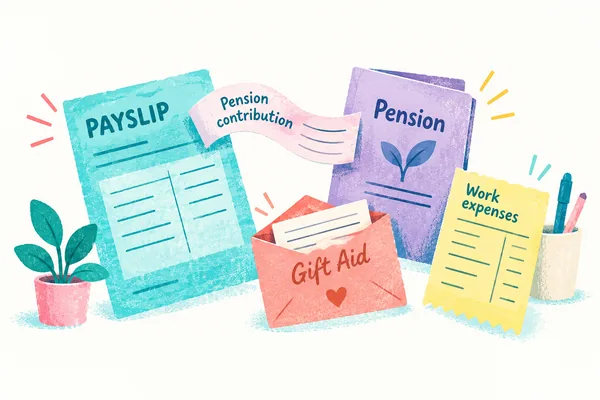
Start with your total income and tax code
PAYE is a way for an employer to collect tax through payroll. It does not prove that the final tax calculation is correct, especially if you change jobs, have more than one job, receive taxable benefits or have other income.
Check your personal details, tax code, taxable benefits and year-to-date pay against your payslips and HMRC account. Tell HMRC about a job change, company car, medical benefit or pension income. If you complete Self Assessment, reconcile the return to your P60, P11D and other records rather than relying on the tax code alone.
Use pension contributions with the limits in mind
Eligible contributions to a registered pension can reduce the income on which you pay tax or qualify for pension tax relief. In a workplace net-pay arrangement, contributions are deducted before Income Tax. Under relief at source, the provider usually adds basic-rate relief. A higher-rate or additional-rate taxpayer may need to claim further relief through Self Assessment or HMRC.
For 2026 to 2027, the standard pension annual allowance is £60,000 across all your pension savings, including employer contributions. It can be lower after flexible access or the high-income taper. Unused annual allowance may be carried forward from the previous three tax years if the conditions are met. Tax relief on personal contributions is generally limited to 100% of your relevant UK earnings, or £3,600 if higher. Check both limits before a large contribution.
Employer salary sacrifice is a contractual change made before you become entitled to the pay. It can reduce taxable salary and, under current rules, National Insurance. It may also affect mortgage evidence, statutory pay, life cover and other salary-linked benefits. Your cash salary cannot be reduced below the National Minimum Wage. The announced National Insurance cap on pension salary sacrifice is due to take effect from 6 April 2029; Income Tax treatment remains subject to the usual pension limits.
Check adjusted net income around key thresholds
Adjusted net income can affect your Personal Allowance and the High Income Child Benefit Charge. For 2026 to 2027, the standard Personal Allowance is £12,570 and it reduces by £1 for every £2 of adjusted net income above £100,000. The Child Benefit charge applies when adjusted net income is over £60,000, reaching the full amount at £80,000.
Gross pension contributions and Gift Aid donations can reduce adjusted net income for these tests. A pension contribution may therefore restore some Personal Allowance or reduce the Child Benefit charge as well as provide pension tax relief. Work out the effect on take-home pay, pension access, childcare eligibility and savings before making a contribution solely to cross a threshold.
Scottish taxpayers have different Income Tax rates and bands for employment income. Use the rules and thresholds for the nation where you are taxed.
Claim relief on Gift Aid donations
Gift Aid lets a UK charity reclaim basic-rate tax on an eligible donation. A £100 donation is treated as £125 gross for tax purposes. If you pay tax above the basic rate, you may be able to claim additional relief on the difference between your rate and basic rate. You can claim through Self Assessment or ask HMRC to adjust your tax code.
Gift Aid also reduces adjusted net income by the grossed-up donation, which can matter near the Personal Allowance taper or Child Benefit threshold. A donation remains a real cost. Tax relief does not make it financially beneficial to give money you did not intend to donate.
Claim eligible expenses you paid for your job
You may be able to claim tax relief on required job expenses you paid yourself, used for work and did not receive back from your employer. Examples include approved professional subscriptions, specialist work clothing, tools and qualifying business travel. Keep receipts, mileage records and evidence that the expense relates to your job. Relief is generally based on the tax rate you pay, not a refund of the full amount spent.
Ordinary clothes worn for work and the cost of commuting to a permanent workplace are not normally allowable. You cannot claim again for costs your employer reimbursed. If you file Self Assessment, claim the relevant expense there.
From 6 April 2026, an employee cannot claim personal Income Tax relief for unreimbursed home-working expenses. An employer may still reimburse qualifying additional household costs when the employee regularly works at home under agreed arrangements. The employer can generally use £6 per week or £26 per month without receipts, or reimburse a higher evidenced amount that does not exceed the employee’s additional costs.
Check allowances that apply to your circumstances
If you are married or in a civil partnership, Marriage Allowance may let a lower-earning partner transfer £1,260 of unused Personal Allowance to a partner who is not taxed above the basic rate. It can reduce the recipient’s tax by up to £252 for the tax year. Check both partners’ income and eligibility before applying. Couples who qualify for the age-related Married Couple’s Allowance have a separate claim.
If you receive savings interest, dividends or other taxable income, check the relevant allowance and reporting rules as well as your employment tax. An ISA can shelter eligible investment income and gains from tax, but it does not reduce Income Tax on salary already earned.
Keep a short annual tax file
Keep P60s, P45s, payslips, P11D information, pension statements, Gift Aid receipts and evidence for employment expense claims. Check that employer benefits and pension contributions appear correctly. Review your tax code after a job or income change and keep copies of any HMRC adjustments.
Correcting a tax code or claiming relief already due can reduce an overpayment. Choosing a pension contribution, donation or salary sacrifice changes what you have available to spend, so compare the after-tax cost and longer-term effect before acting.
Use these links to check a rate, deadline or eligibility rule.
Official sources
- HMRC: adjusted net income
- HMRC: pension annual allowance
- HMRC: rates and allowances for pension schemes
- HMRC: salary sacrifice changes from April 2029
- HMRC: claim tax relief for job expenses
- HMRC: professional fees and subscriptions
- HMRC: removal of tax relief for unreimbursed home-working costs
- HMRC: employer home-working expenses
- HMRC: Gift Aid and Income Tax
- HMRC: Marriage Allowance
- HMRC: High Income Child Benefit Charge
Need help checking your Self Assessment?
We can review your income, expense and pension records and agree the return work you need.
Discuss Self Assessment support